



Sunday, March 13, 2011


Thursday, March 10, 2011


Tuesday, March 8, 2011
LIBYA: THE STRUGGLE TO REPORT
Early in the morning we hired a taxi to take us to Benghazi some 500 kilometres from Tubruk. The previous night after flying half way across the world we had driven almost a thousand kilometres. Another group of journalists joined us and our cavalcade zipped through the cold north African desert. Nothing but rocks and sand for miles. The road was smooth. All cars were headed in the opposite direction – towards Egypt. Cars, buses and trucks all loaded beyond capacity with suitcases and bags piled on rooftops and hanging precariously from the sides. 300 kilometres and 3 hours later the landscape changed suddenly. The sand was replaced by red soil and rocks by lush green grass and trees. The sun disappeared behind clouds and it began to rain. A good omen I thought. As temperature dropped further I asked the driver to roll up his side of the window. It is broken, he smiled. I saw no reason too. Despite three layers of clothing, both Shiv and I were cold and wet.
We reached Benghazi by 5 in the evening. It was deserted. A ghost town. The vibes were rather negative. The first hotel we went to refused to take us. The rates had shot up to $ 200 per day. Every hotel had only journalists from all over the world. We then moved to Tibesty hotel – locals say the best in the city. The hotel had no rooms and no internet. Our hearts sank.
Early in the morning at Turbruk I had requested a Japanese journalist if we could use his Beegan system to uplink just two pieces to camera to India – just to establish our presence in Libya. He had very kindly consented. It must have cost his company a packet but he refused to accept the money we offered, In my school days I had read somewhere that Japanese were very helpful people. This action had confirmed it. Colonel Muammar Gaddafi’s Libya had no internet. We had no means to send our feed to India.
Since phone lines were down we could not even ask our office in New Delhi to book a 10 minute feed for us either through the Associated Press or the EBU. We sent smses but none reached Delhi. We were cold and hungry but since both Shiv and I cover security issues and spend time with soldiers from across the world – our morale usually remains high. By late evening one journalist checked out of the hotel – moving back to Cairo because he had not been able to communicate with his office for 6 days. We checked into his room. We went to the town centre and were amazed to see thousands of Libyans assembled there – singing – dancing celebrating ``freedom from Gaddafi.’’
``This is real freedom. Two generations have not experienced this,’’ said a 50-year-old. Colonel Muammar Gaddafi has been at the helm of affairs for 42 years and with the much feared intelligence agents all over – nobody ever spoke their mind. This time they not only abused Gaddafi openly – savouring every word like a sweet dessert – they also openly talked of democracy, rights and freedom. ``Had we done so even three months earlier we would have been locked up in a secret prison and our family would never have heard of us,’’ he added.
Little children played on tanks that had been sent to crush the movement. A major part of the Libyan army deployed in the east rebelled against Gaddafi and joined the freedom fighters. There was a carnival at the square on the Mediterranean coast. Despite the icy wind people were rejoicing in the new found freedom. Even if some seniors warned the celebrations were a bit premature. The people of Benghazi may have succeeded in pushing back Gaddafi’s forces freedom is still a distant dream.
Distances in this country are killing. From Tubruk to Benghazi was more than 500 kilometres. Aj Dabiah and Brega where pitched battles took place between forces loyal to and opposing Gaddafi were another 200 to 300 kilometres away. Ras Lanuf the major oil hub and port another 500 kilometres away from Benghazi. In the next 48 hours Shiv and I travelled to all these places.
With Issam Khalil, an expat who returned to join the freedom struggle we followed a convoy of fighters from Benghazi to Ras Lanuf. This was an experience I will never forget. But more on it later.
(to be continued…)
Sunday, March 6, 2011
DATELINE LIBYA: IN HARM'S WAY
Crossing over illegally into Libya was the aim. Armed with a multiple entry visa to Egypt and Tunisia Shiv Aroor and I boarded the Etihad flight from Delhi to Abu Dhabi and then to Cairo.
Within an hour of landing in Cairo we left for Sallum – the border between Egypt and Libya. The 800 kilometre long journey through the changing landscape and the famous second world war battlefield Al Alamien took almost a lifetime – despite our car zipping across at 140 kmph. The drive to the border was cold and tense. The border was cold and windy. There were thousands of people – Indians, Bangladeshis, Nepalis, Egyptians desperately waiting to cross over to safety into Egypt.
Shiv and I were the only two trying to cross over into Libya. In harm’s way. The border security personnel could not believe with no back up, no fixers and no local help – two journalists who did not even speak Arabic and had no idea about what to expect across the fence in cold desert – were desperate to cross over.
The Egyptians were friendly. They turned a blind eye as Shiv and I began interviewing the evacuees at the border post and then quietly had exit stamped on our passports and slipped across the barbed wire fence well past midnight.
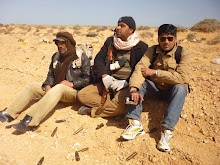
As we walked along the no man’s land we almost expected a shout or a burst of AK fire. Or were we being too dramatic. Across the Libyan border – armed civilians – some in battle fatigues stopped us. Checked our passports. ``Welcome to the peoples’ Democratic Republic of Libya free of Gaddafi,’’ said one. We instantly felt at home. One of them offered us a cigarette. I declined Shiv accepted. We had some pictures taken before they waved an oncoming car – that had dropped some evacuees to Egypt – to take us to Tubruk, a magical tourist town on the Mediterranian sea coast some 150 kilometres inside east Libya.
``Into fate’s hands,’’ said Shiv. We had absolutely no idea who the driver was. He did not speak English and we did not speak Arabic. At night we had absolutely no idea where he was taking us. There were burnt cars all along the highway. Lights were lit in every house but there was not a soul in sight for miles. We were too scared to even doze off. After flying from India to Egypt for 12 hours and driving non stop for another 12, we were tired, hungry and sleepy. But dared not sleep. But our fears were totally unfounded.
The driver took us into Masera hotel in Tubruk. It was a surreal experience. From crossing over into Libya illegally here we were in a swanky five star deluxe hotel. Except for two other journalists the hotel was empty. The hotel staff did not even ask where we came from and why. They saw our passports and gave us the room keys. But kept our passports with them. That was scary. In a strange land with passports not with us. A very scary thought but the hotel manager showed us the passports of other journalists too. Both of us were too tired to argue. We walked into our rooms and even before the door shut we crashed out.
(to be continued…)
Friday, February 11, 2011
THE ROAR OF DEMOCRACY IN CAIRO
The roar of democracy will shatter the window panes of the Presidential palace and the ear drums of the regime, scream protesters at the Al-Tahrir square. It is people power versus the President in Egypt. The embattled president Hosni Mubarak has once again sidestepped the overwhelming demand to step down. He is giving up power drop by drop, talking about delegating some responsibilities to the vice president Omar Suleiman. But this has angered the protesters even more. There was a massive build up to the presidential address. The secretary general of the national democratic party Hossam Badrawy indicated the president had been advised to step down. The supreme council of the armed forces met and a spokesperson said the peoples' demands will be met. Thousands and thousands rushed to the Liberation Square - all wanting to be a part of history being made. They wanted to be there and experience change. They were bitterly disappointed. I spent a week at the Al-Tahrir square and it is an island of democracy in midst of a sea of uniform.
In unity lies their strength. And more and more people are pouring into the Al-Tahrir square to boost the morale of those camping there for the past 18 days. All eyes are on the all powerful Egyptian Army, an institution well respected by the masses. While covering the Friday - Day of Departure protests - last week at the Al-Tahrir square in Cairo I had met and interacted with an Egyptian army colonel. There was a major general personally supervising security arrangements and several other senior officers standing by. They were at ease - smiling and receiving friendly salutes from the masses. Little children begged to have pictures taken with them.
A Major of the Egyptian Army Parachute Regiment and two other officers walked into the Square and were almost lifted on the shoulders by the pro-democracy protesters. The army permitted the protesters to sleep on the tank tracks as a symbolic gesture to ensure the tanks do not move. Will the army continue to stand by tonight and in the days to come? The army’s supreme council has told the people it will ensure smooth transition to democracy and wants the people to go home. The vice president Omar Suleiman has said the same thing. One thing is clear the army is the establishment in Egypt.
Will the protesters take on the army ? Can there be a Tiananmen Square at the Tahrir Square? As of now it appears not just unlikely but nearly impossible. Why? Egypt is no China. They might have an authoritarian regime but the masses have well and truly smelt the sweet smell of freedom. It is intoxicating. The whiff of Jasmine will anyday overcome the smell of burnt gunpowder. The people are certain that their own army will not open fire on them.
The people are fighting against president Hosni Mubarak and not the army - even though for many they have been two sides of the same coin. The army has stakes in the country and will ensure it does not go to the dogs. They will not let mobs rule the streets of Cairo - not even at the Qasr el Nil or 6 October Bridge. The army will stand by and watch the masses protest peacefully. The army, it appears, will tire them out. The army too appears to be realising Mubarak is not Egypt. Ultimately the army will choose Egypt over the man who ruled it for 30 years. The roar of democracy will shatter whatever illusions remain. The revolution is successful. Egypt has arisen and the world is watching.
Even if the protesters go home, or are made to go home they have achieved their aim. It will not be back to business as usual for the ruling elite. Change will come.
Freedom will come to the people of Egypt. The question now is not if but when.
Thursday, February 10, 2011
IN CAIRO: TECHNOLOGY TO THE RESCUE
When the government in Egypt said foreign journalists could not use television cameras to film the protests and events as they unfolded before the all important Day of Departure Friday protests, I used my mobile camera to shoot.
That time it was not the quality of pictures - but the fact that pictures could be taken and sent at all - that was more important.
Pro-Mubarak protesters ensured many journalists could not step out of their hotels, but we were lucky. I accompanied a group of protesters and entered the heavily fortified Al-Tahrir square with them. And used my mobile phone to tell the story.
There was a story to tell and this was the only way to do it.
Technology came to my rescue again when I used a mobile phone to connect to the Headlines Today studio in Delhi and did a live report form the Al Tahrir square.
Subscribe to:
Posts (Atom)