



Thursday, March 10, 2011


Tuesday, March 8, 2011
LIBYA: THE STRUGGLE TO REPORT
Early in the morning we hired a taxi to take us to Benghazi some 500 kilometres from Tubruk. The previous night after flying half way across the world we had driven almost a thousand kilometres. Another group of journalists joined us and our cavalcade zipped through the cold north African desert. Nothing but rocks and sand for miles. The road was smooth. All cars were headed in the opposite direction – towards Egypt. Cars, buses and trucks all loaded beyond capacity with suitcases and bags piled on rooftops and hanging precariously from the sides. 300 kilometres and 3 hours later the landscape changed suddenly. The sand was replaced by red soil and rocks by lush green grass and trees. The sun disappeared behind clouds and it began to rain. A good omen I thought. As temperature dropped further I asked the driver to roll up his side of the window. It is broken, he smiled. I saw no reason too. Despite three layers of clothing, both Shiv and I were cold and wet.
We reached Benghazi by 5 in the evening. It was deserted. A ghost town. The vibes were rather negative. The first hotel we went to refused to take us. The rates had shot up to $ 200 per day. Every hotel had only journalists from all over the world. We then moved to Tibesty hotel – locals say the best in the city. The hotel had no rooms and no internet. Our hearts sank.
Early in the morning at Turbruk I had requested a Japanese journalist if we could use his Beegan system to uplink just two pieces to camera to India – just to establish our presence in Libya. He had very kindly consented. It must have cost his company a packet but he refused to accept the money we offered, In my school days I had read somewhere that Japanese were very helpful people. This action had confirmed it. Colonel Muammar Gaddafi’s Libya had no internet. We had no means to send our feed to India.
Since phone lines were down we could not even ask our office in New Delhi to book a 10 minute feed for us either through the Associated Press or the EBU. We sent smses but none reached Delhi. We were cold and hungry but since both Shiv and I cover security issues and spend time with soldiers from across the world – our morale usually remains high. By late evening one journalist checked out of the hotel – moving back to Cairo because he had not been able to communicate with his office for 6 days. We checked into his room. We went to the town centre and were amazed to see thousands of Libyans assembled there – singing – dancing celebrating ``freedom from Gaddafi.’’
``This is real freedom. Two generations have not experienced this,’’ said a 50-year-old. Colonel Muammar Gaddafi has been at the helm of affairs for 42 years and with the much feared intelligence agents all over – nobody ever spoke their mind. This time they not only abused Gaddafi openly – savouring every word like a sweet dessert – they also openly talked of democracy, rights and freedom. ``Had we done so even three months earlier we would have been locked up in a secret prison and our family would never have heard of us,’’ he added.
Little children played on tanks that had been sent to crush the movement. A major part of the Libyan army deployed in the east rebelled against Gaddafi and joined the freedom fighters. There was a carnival at the square on the Mediterranean coast. Despite the icy wind people were rejoicing in the new found freedom. Even if some seniors warned the celebrations were a bit premature. The people of Benghazi may have succeeded in pushing back Gaddafi’s forces freedom is still a distant dream.
Distances in this country are killing. From Tubruk to Benghazi was more than 500 kilometres. Aj Dabiah and Brega where pitched battles took place between forces loyal to and opposing Gaddafi were another 200 to 300 kilometres away. Ras Lanuf the major oil hub and port another 500 kilometres away from Benghazi. In the next 48 hours Shiv and I travelled to all these places.
With Issam Khalil, an expat who returned to join the freedom struggle we followed a convoy of fighters from Benghazi to Ras Lanuf. This was an experience I will never forget. But more on it later.
(to be continued…)
We reached Benghazi by 5 in the evening. It was deserted. A ghost town. The vibes were rather negative. The first hotel we went to refused to take us. The rates had shot up to $ 200 per day. Every hotel had only journalists from all over the world. We then moved to Tibesty hotel – locals say the best in the city. The hotel had no rooms and no internet. Our hearts sank.
Early in the morning at Turbruk I had requested a Japanese journalist if we could use his Beegan system to uplink just two pieces to camera to India – just to establish our presence in Libya. He had very kindly consented. It must have cost his company a packet but he refused to accept the money we offered, In my school days I had read somewhere that Japanese were very helpful people. This action had confirmed it. Colonel Muammar Gaddafi’s Libya had no internet. We had no means to send our feed to India.
Since phone lines were down we could not even ask our office in New Delhi to book a 10 minute feed for us either through the Associated Press or the EBU. We sent smses but none reached Delhi. We were cold and hungry but since both Shiv and I cover security issues and spend time with soldiers from across the world – our morale usually remains high. By late evening one journalist checked out of the hotel – moving back to Cairo because he had not been able to communicate with his office for 6 days. We checked into his room. We went to the town centre and were amazed to see thousands of Libyans assembled there – singing – dancing celebrating ``freedom from Gaddafi.’’
``This is real freedom. Two generations have not experienced this,’’ said a 50-year-old. Colonel Muammar Gaddafi has been at the helm of affairs for 42 years and with the much feared intelligence agents all over – nobody ever spoke their mind. This time they not only abused Gaddafi openly – savouring every word like a sweet dessert – they also openly talked of democracy, rights and freedom. ``Had we done so even three months earlier we would have been locked up in a secret prison and our family would never have heard of us,’’ he added.
Little children played on tanks that had been sent to crush the movement. A major part of the Libyan army deployed in the east rebelled against Gaddafi and joined the freedom fighters. There was a carnival at the square on the Mediterranean coast. Despite the icy wind people were rejoicing in the new found freedom. Even if some seniors warned the celebrations were a bit premature. The people of Benghazi may have succeeded in pushing back Gaddafi’s forces freedom is still a distant dream.
Distances in this country are killing. From Tubruk to Benghazi was more than 500 kilometres. Aj Dabiah and Brega where pitched battles took place between forces loyal to and opposing Gaddafi were another 200 to 300 kilometres away. Ras Lanuf the major oil hub and port another 500 kilometres away from Benghazi. In the next 48 hours Shiv and I travelled to all these places.
With Issam Khalil, an expat who returned to join the freedom struggle we followed a convoy of fighters from Benghazi to Ras Lanuf. This was an experience I will never forget. But more on it later.
(to be continued…)
Sunday, March 6, 2011
DATELINE LIBYA: IN HARM'S WAY
Crossing over illegally into Libya was the aim. Armed with a multiple entry visa to Egypt and Tunisia Shiv Aroor and I boarded the Etihad flight from Delhi to Abu Dhabi and then to Cairo.
Within an hour of landing in Cairo we left for Sallum – the border between Egypt and Libya. The 800 kilometre long journey through the changing landscape and the famous second world war battlefield Al Alamien took almost a lifetime – despite our car zipping across at 140 kmph. The drive to the border was cold and tense. The border was cold and windy. There were thousands of people – Indians, Bangladeshis, Nepalis, Egyptians desperately waiting to cross over to safety into Egypt.
Shiv and I were the only two trying to cross over into Libya. In harm’s way. The border security personnel could not believe with no back up, no fixers and no local help – two journalists who did not even speak Arabic and had no idea about what to expect across the fence in cold desert – were desperate to cross over.
The Egyptians were friendly. They turned a blind eye as Shiv and I began interviewing the evacuees at the border post and then quietly had exit stamped on our passports and slipped across the barbed wire fence well past midnight.
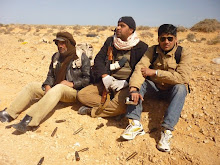
As we walked along the no man’s land we almost expected a shout or a burst of AK fire. Or were we being too dramatic. Across the Libyan border – armed civilians – some in battle fatigues stopped us. Checked our passports. ``Welcome to the peoples’ Democratic Republic of Libya free of Gaddafi,’’ said one. We instantly felt at home. One of them offered us a cigarette. I declined Shiv accepted. We had some pictures taken before they waved an oncoming car – that had dropped some evacuees to Egypt – to take us to Tubruk, a magical tourist town on the Mediterranian sea coast some 150 kilometres inside east Libya.
``Into fate’s hands,’’ said Shiv. We had absolutely no idea who the driver was. He did not speak English and we did not speak Arabic. At night we had absolutely no idea where he was taking us. There were burnt cars all along the highway. Lights were lit in every house but there was not a soul in sight for miles. We were too scared to even doze off. After flying from India to Egypt for 12 hours and driving non stop for another 12, we were tired, hungry and sleepy. But dared not sleep. But our fears were totally unfounded.
The driver took us into Masera hotel in Tubruk. It was a surreal experience. From crossing over into Libya illegally here we were in a swanky five star deluxe hotel. Except for two other journalists the hotel was empty. The hotel staff did not even ask where we came from and why. They saw our passports and gave us the room keys. But kept our passports with them. That was scary. In a strange land with passports not with us. A very scary thought but the hotel manager showed us the passports of other journalists too. Both of us were too tired to argue. We walked into our rooms and even before the door shut we crashed out.
(to be continued…)
Within an hour of landing in Cairo we left for Sallum – the border between Egypt and Libya. The 800 kilometre long journey through the changing landscape and the famous second world war battlefield Al Alamien took almost a lifetime – despite our car zipping across at 140 kmph. The drive to the border was cold and tense. The border was cold and windy. There were thousands of people – Indians, Bangladeshis, Nepalis, Egyptians desperately waiting to cross over to safety into Egypt.
Shiv and I were the only two trying to cross over into Libya. In harm’s way. The border security personnel could not believe with no back up, no fixers and no local help – two journalists who did not even speak Arabic and had no idea about what to expect across the fence in cold desert – were desperate to cross over.
The Egyptians were friendly. They turned a blind eye as Shiv and I began interviewing the evacuees at the border post and then quietly had exit stamped on our passports and slipped across the barbed wire fence well past midnight.
As we walked along the no man’s land we almost expected a shout or a burst of AK fire. Or were we being too dramatic. Across the Libyan border – armed civilians – some in battle fatigues stopped us. Checked our passports. ``Welcome to the peoples’ Democratic Republic of Libya free of Gaddafi,’’ said one. We instantly felt at home. One of them offered us a cigarette. I declined Shiv accepted. We had some pictures taken before they waved an oncoming car – that had dropped some evacuees to Egypt – to take us to Tubruk, a magical tourist town on the Mediterranian sea coast some 150 kilometres inside east Libya.
``Into fate’s hands,’’ said Shiv. We had absolutely no idea who the driver was. He did not speak English and we did not speak Arabic. At night we had absolutely no idea where he was taking us. There were burnt cars all along the highway. Lights were lit in every house but there was not a soul in sight for miles. We were too scared to even doze off. After flying from India to Egypt for 12 hours and driving non stop for another 12, we were tired, hungry and sleepy. But dared not sleep. But our fears were totally unfounded.
The driver took us into Masera hotel in Tubruk. It was a surreal experience. From crossing over into Libya illegally here we were in a swanky five star deluxe hotel. Except for two other journalists the hotel was empty. The hotel staff did not even ask where we came from and why. They saw our passports and gave us the room keys. But kept our passports with them. That was scary. In a strange land with passports not with us. A very scary thought but the hotel manager showed us the passports of other journalists too. Both of us were too tired to argue. We walked into our rooms and even before the door shut we crashed out.
(to be continued…)
Friday, February 11, 2011
THE ROAR OF DEMOCRACY IN CAIRO
The roar of democracy will shatter the window panes of the Presidential palace and the ear drums of the regime, scream protesters at the Al-Tahrir square. It is people power versus the President in Egypt. The embattled president Hosni Mubarak has once again sidestepped the overwhelming demand to step down. He is giving up power drop by drop, talking about delegating some responsibilities to the vice president Omar Suleiman. But this has angered the protesters even more. There was a massive build up to the presidential address. The secretary general of the national democratic party Hossam Badrawy indicated the president had been advised to step down. The supreme council of the armed forces met and a spokesperson said the peoples' demands will be met. Thousands and thousands rushed to the Liberation Square - all wanting to be a part of history being made. They wanted to be there and experience change. They were bitterly disappointed. I spent a week at the Al-Tahrir square and it is an island of democracy in midst of a sea of uniform.
In unity lies their strength. And more and more people are pouring into the Al-Tahrir square to boost the morale of those camping there for the past 18 days. All eyes are on the all powerful Egyptian Army, an institution well respected by the masses. While covering the Friday - Day of Departure protests - last week at the Al-Tahrir square in Cairo I had met and interacted with an Egyptian army colonel. There was a major general personally supervising security arrangements and several other senior officers standing by. They were at ease - smiling and receiving friendly salutes from the masses. Little children begged to have pictures taken with them.
A Major of the Egyptian Army Parachute Regiment and two other officers walked into the Square and were almost lifted on the shoulders by the pro-democracy protesters. The army permitted the protesters to sleep on the tank tracks as a symbolic gesture to ensure the tanks do not move. Will the army continue to stand by tonight and in the days to come? The army’s supreme council has told the people it will ensure smooth transition to democracy and wants the people to go home. The vice president Omar Suleiman has said the same thing. One thing is clear the army is the establishment in Egypt.
Will the protesters take on the army ? Can there be a Tiananmen Square at the Tahrir Square? As of now it appears not just unlikely but nearly impossible. Why? Egypt is no China. They might have an authoritarian regime but the masses have well and truly smelt the sweet smell of freedom. It is intoxicating. The whiff of Jasmine will anyday overcome the smell of burnt gunpowder. The people are certain that their own army will not open fire on them.
The people are fighting against president Hosni Mubarak and not the army - even though for many they have been two sides of the same coin. The army has stakes in the country and will ensure it does not go to the dogs. They will not let mobs rule the streets of Cairo - not even at the Qasr el Nil or 6 October Bridge. The army will stand by and watch the masses protest peacefully. The army, it appears, will tire them out. The army too appears to be realising Mubarak is not Egypt. Ultimately the army will choose Egypt over the man who ruled it for 30 years. The roar of democracy will shatter whatever illusions remain. The revolution is successful. Egypt has arisen and the world is watching.
Even if the protesters go home, or are made to go home they have achieved their aim. It will not be back to business as usual for the ruling elite. Change will come.
Freedom will come to the people of Egypt. The question now is not if but when.
In unity lies their strength. And more and more people are pouring into the Al-Tahrir square to boost the morale of those camping there for the past 18 days. All eyes are on the all powerful Egyptian Army, an institution well respected by the masses. While covering the Friday - Day of Departure protests - last week at the Al-Tahrir square in Cairo I had met and interacted with an Egyptian army colonel. There was a major general personally supervising security arrangements and several other senior officers standing by. They were at ease - smiling and receiving friendly salutes from the masses. Little children begged to have pictures taken with them.
A Major of the Egyptian Army Parachute Regiment and two other officers walked into the Square and were almost lifted on the shoulders by the pro-democracy protesters. The army permitted the protesters to sleep on the tank tracks as a symbolic gesture to ensure the tanks do not move. Will the army continue to stand by tonight and in the days to come? The army’s supreme council has told the people it will ensure smooth transition to democracy and wants the people to go home. The vice president Omar Suleiman has said the same thing. One thing is clear the army is the establishment in Egypt.
Will the protesters take on the army ? Can there be a Tiananmen Square at the Tahrir Square? As of now it appears not just unlikely but nearly impossible. Why? Egypt is no China. They might have an authoritarian regime but the masses have well and truly smelt the sweet smell of freedom. It is intoxicating. The whiff of Jasmine will anyday overcome the smell of burnt gunpowder. The people are certain that their own army will not open fire on them.
The people are fighting against president Hosni Mubarak and not the army - even though for many they have been two sides of the same coin. The army has stakes in the country and will ensure it does not go to the dogs. They will not let mobs rule the streets of Cairo - not even at the Qasr el Nil or 6 October Bridge. The army will stand by and watch the masses protest peacefully. The army, it appears, will tire them out. The army too appears to be realising Mubarak is not Egypt. Ultimately the army will choose Egypt over the man who ruled it for 30 years. The roar of democracy will shatter whatever illusions remain. The revolution is successful. Egypt has arisen and the world is watching.
Even if the protesters go home, or are made to go home they have achieved their aim. It will not be back to business as usual for the ruling elite. Change will come.
Freedom will come to the people of Egypt. The question now is not if but when.
Thursday, February 10, 2011
IN CAIRO: TECHNOLOGY TO THE RESCUE
When the government in Egypt said foreign journalists could not use television cameras to film the protests and events as they unfolded before the all important Day of Departure Friday protests, I used my mobile camera to shoot.
That time it was not the quality of pictures - but the fact that pictures could be taken and sent at all - that was more important.
Pro-Mubarak protesters ensured many journalists could not step out of their hotels, but we were lucky. I accompanied a group of protesters and entered the heavily fortified Al-Tahrir square with them. And used my mobile phone to tell the story.
There was a story to tell and this was the only way to do it.
Technology came to my rescue again when I used a mobile phone to connect to the Headlines Today studio in Delhi and did a live report form the Al Tahrir square.
That time it was not the quality of pictures - but the fact that pictures could be taken and sent at all - that was more important.
Pro-Mubarak protesters ensured many journalists could not step out of their hotels, but we were lucky. I accompanied a group of protesters and entered the heavily fortified Al-Tahrir square with them. And used my mobile phone to tell the story.
There was a story to tell and this was the only way to do it.
Technology came to my rescue again when I used a mobile phone to connect to the Headlines Today studio in Delhi and did a live report form the Al Tahrir square.
Wednesday, February 9, 2011
RISE OF THE ARAB STREET
A SPECIAL GROUND REPORT CARRIED IN THE INDIA TODAY MAGAZINE
Gaurav C. Sawant | Cairo
Egyptians rally in Cairo to demand President Hosni Mubarak's resignation
The chants of 'Go Mubarak Go' at Tahrir Square in Cairo are rivalled by the pro-Hosni Mubarak slogans requesting the 'beloved leader' to stay on for the country. State-sponsored vigilantes are on the street clashing with pro-democracy protesters. The tottering Egyptian president's televised address, insisting he would step down in September, was booed by thousands of freedom marchers.
Pro-Mubarak demonstrators attacked me and other members of the Headlines Today team, hitting the cameraman for shooting visuals of only anti-Mubarak demonstrators and not of Mubarak supporters. They accused the team of being a part of a "hostile Arab channel". The cameraman was beaten up and his camera tripod broken. They also yanked out the tape and smashed it. "I tried to tell them I am an Indian and not an Arab but the mob does not listen," said cameraman Tahir Chowdhary.
The attackers relented only when we showed our passports. "We kept saying we are Sahafi al Hind (Indian journalists). But the mob was not listening. It was only when a section of the mob saw the passports and intervened did the rest of the mob relent and then targeted another group journalists," said Chowdhary. They also roughed up several foreign journalists covering the crisis in Cairo, accusing them of deliberately trying to destabilise the Mubarak regime.
Braving chilly winds and 4ºC temperatures are the 'freedom fighters' who insist they will continue to fight for change even if the army opens fire. This is battleground Egypt. For the first time ever people have dared to defy the state in such large numbers.
Protesters use a shoe to disgrace an image of Mubarak woven into a carpetThe Jasmine Revolution of Tunisia has spread to Egypt and a whiff of freedom is in the air. "This time we will be free. Allah is with us," says Dr Nashwa Salah, professor of philosophy at Cairo's prestigious Ain Shams University. Many tents have come up at the roundabout at Tahrir Square. Thousands of people camping through the week, saying they will leave only when Mubarak leaves. Twenty-eight-year-old Salma Sayed teaches interactive theatre to schoolchildren. "But this is no drama. This is an issue of our life and death. I am here with my parents and entire family. Our entire neighbourhood is camping here," she says.
This is the most unique aspect of this movement. Men, women, children, some as young as five, are taking part in an effort for what they say is Egypt's brighter future. But what is the future when the 82-year-old president who has ruled with an iron fist for over three decades refuses to step down? "I do not know if it will be Mohamed ElBaradei or Omar Suleiman. But even the Muslim Brotherhood cannot be as bad as Mubarak," adds Yaseer Beraka, an engineer from Fayaum who came to Cairo to join the protesters.
A former International Atomic Energy Agency chief and Nobel Peace Prize winner, ElBaradei is the face of moderate upper class Egypt. He has returned to Egypt and is being seen as the spearhead of the movement against Mubarak. He said the president's concessions are too little and too late. He has the support of the youth and the intelligentsia but lacks a mass base. His critics insist he has spent so much time in Vienna that he has completely lost touch with ground realities and the issues concerning the masses in Egypt.
Suleiman, the former chief of intelligence and the newly appointed vice- president, is seen as the acceptable face of transition to democracy.
Then there is also Field Marshal Mohamed Tantawi. He is the country's deputy prime minister and defence minister. He controls the army and has played an extremely crucial role in shaping the army's measured response. He has said to have instructed the army not to open fire at the protesters and that news has led to his popularity increasing.
Nobel laureate Mohamed ElBaradei, who is the face of moderate upper class Egypt, is the focus of the movement against Mubarak.
"There is also Ayman Nour, the leader of the Al-Ghad party. In the 2005 elections he was very popular but those elections were rigged. He could also be a part of the transition government. More and more people should have a voice. In fact, Mubarak had him jailed because of his rising popularity," says Aisha Shehab, a Nour supporter.
The Muslim Brotherhood, though officially banned, is the biggest opposition group with grassroots support. It will play a key role in the formation of the next government. The Brotherhood's main support base lies in the rural areas among the downtrodden. They lack a mass base in urban areas especially since they insist they want Egypt to be an Islamic state ruled by the Sharia. Their supporters are moving on the streets carrying banners that read "Islam is the only solution to the crisis".
The Muslim Brotherhood has said that ElBaradei is acceptable to them and experts say a combination of ElBaradei and the Muslim Brotherhood could pave the way for a smoother and widely acceptable transition model. One thing is clear, the army will have a major say and role to play in the future of Egypt with Mubarak losing his moral legitimacy to rule. Experts say he is and will remain at the mercy of the army.
Both pro- and anti-Mubarak supporters want peace to prevail and insist they do not want Egypt to become another Iraq. But the country has come to a virtual standstill. Schools, colleges, offices, shops, malls, banks, the stock market are all closed. There is no public transport. Not even neighbourhood shops are opening in the non-curfew morning hours. "I have run out of food. What do I feed my children?" asks Tariq Sadiq, a school teacher. Truckers fear looting and burning, so they are unwilling to ferry cargo to Cairo. The police, virtually non-existent on the streets, are forcing youngsters to form neighbourhood watch schemes to protect their homes and surroundings from looters.
Mohamed ElBaradei addresses the crowd at Tahrir Square in CairoOverall the country is descending into chaos. And many say this is being encouraged purposely by the embattled president to give the people an impression of the chaos that the country will be engulfed in if he quits.
Anarchy in Egypt would mean trouble in the Arab world and its impact will be felt in more ways than one across the globe. The Suez Canal, the shortest link between the East and the West due to its extremely unique geographical location, is one of the world's most critical navigation channels. The canal is still open but there is no loading and unloading of cargo at the ports since workers are staying away due to the crisis. The added tension to the world is what happens if the route that connects the Gulf of Suez with the Mediterranean Sea is shut down. More than 2.5 million barrels of oil, which is more than 2 per cent of the global production, pass through the canal each day and any trouble in the canal would mean the entire sea trade will have to pass through the Cape of Good Hope adding another 6,000 miles to the journey. That would mean loss of time and money.
A hostile Egypt is Israel's worst nightmare coming true again. If the peace treaty with Egypt collapses, Israel will have to rewrite its security doctrine after three decades of peace. A major military threat to Israel's southern border would only embolden Hamas in Palestine and divide the Israeli forces. The Egyptian army is well equipped with American military hardware. The American-trained Egyptian army numbers more than 6,50,000 troops with 60 combat brigades, more than 3,500 tanks and 600 fighter planes, including American F-16s.
Israel's worst nightmare would be a regime change both in Egypt and Jordan where it would return to a 1977-like situation facing a hostile combined Arab army of Egypt, Lebanon, Syria, Jordan and Palestinian fighters.
Tunisia was a wave sparked by one young man setting himself alight. Egypt has the power to amplify that wave into a tsunami of change across the Arab world.
Gaurav C. Sawant is deputy editor with Headlines Today
Gaurav C. Sawant | Cairo
Egyptians rally in Cairo to demand President Hosni Mubarak's resignation
The chants of 'Go Mubarak Go' at Tahrir Square in Cairo are rivalled by the pro-Hosni Mubarak slogans requesting the 'beloved leader' to stay on for the country. State-sponsored vigilantes are on the street clashing with pro-democracy protesters. The tottering Egyptian president's televised address, insisting he would step down in September, was booed by thousands of freedom marchers.
Pro-Mubarak demonstrators attacked me and other members of the Headlines Today team, hitting the cameraman for shooting visuals of only anti-Mubarak demonstrators and not of Mubarak supporters. They accused the team of being a part of a "hostile Arab channel". The cameraman was beaten up and his camera tripod broken. They also yanked out the tape and smashed it. "I tried to tell them I am an Indian and not an Arab but the mob does not listen," said cameraman Tahir Chowdhary.
The attackers relented only when we showed our passports. "We kept saying we are Sahafi al Hind (Indian journalists). But the mob was not listening. It was only when a section of the mob saw the passports and intervened did the rest of the mob relent and then targeted another group journalists," said Chowdhary. They also roughed up several foreign journalists covering the crisis in Cairo, accusing them of deliberately trying to destabilise the Mubarak regime.
Braving chilly winds and 4ºC temperatures are the 'freedom fighters' who insist they will continue to fight for change even if the army opens fire. This is battleground Egypt. For the first time ever people have dared to defy the state in such large numbers.
Protesters use a shoe to disgrace an image of Mubarak woven into a carpetThe Jasmine Revolution of Tunisia has spread to Egypt and a whiff of freedom is in the air. "This time we will be free. Allah is with us," says Dr Nashwa Salah, professor of philosophy at Cairo's prestigious Ain Shams University. Many tents have come up at the roundabout at Tahrir Square. Thousands of people camping through the week, saying they will leave only when Mubarak leaves. Twenty-eight-year-old Salma Sayed teaches interactive theatre to schoolchildren. "But this is no drama. This is an issue of our life and death. I am here with my parents and entire family. Our entire neighbourhood is camping here," she says.
This is the most unique aspect of this movement. Men, women, children, some as young as five, are taking part in an effort for what they say is Egypt's brighter future. But what is the future when the 82-year-old president who has ruled with an iron fist for over three decades refuses to step down? "I do not know if it will be Mohamed ElBaradei or Omar Suleiman. But even the Muslim Brotherhood cannot be as bad as Mubarak," adds Yaseer Beraka, an engineer from Fayaum who came to Cairo to join the protesters.
A former International Atomic Energy Agency chief and Nobel Peace Prize winner, ElBaradei is the face of moderate upper class Egypt. He has returned to Egypt and is being seen as the spearhead of the movement against Mubarak. He said the president's concessions are too little and too late. He has the support of the youth and the intelligentsia but lacks a mass base. His critics insist he has spent so much time in Vienna that he has completely lost touch with ground realities and the issues concerning the masses in Egypt.
Suleiman, the former chief of intelligence and the newly appointed vice- president, is seen as the acceptable face of transition to democracy.
Then there is also Field Marshal Mohamed Tantawi. He is the country's deputy prime minister and defence minister. He controls the army and has played an extremely crucial role in shaping the army's measured response. He has said to have instructed the army not to open fire at the protesters and that news has led to his popularity increasing.
Nobel laureate Mohamed ElBaradei, who is the face of moderate upper class Egypt, is the focus of the movement against Mubarak.
"There is also Ayman Nour, the leader of the Al-Ghad party. In the 2005 elections he was very popular but those elections were rigged. He could also be a part of the transition government. More and more people should have a voice. In fact, Mubarak had him jailed because of his rising popularity," says Aisha Shehab, a Nour supporter.
The Muslim Brotherhood, though officially banned, is the biggest opposition group with grassroots support. It will play a key role in the formation of the next government. The Brotherhood's main support base lies in the rural areas among the downtrodden. They lack a mass base in urban areas especially since they insist they want Egypt to be an Islamic state ruled by the Sharia. Their supporters are moving on the streets carrying banners that read "Islam is the only solution to the crisis".
The Muslim Brotherhood has said that ElBaradei is acceptable to them and experts say a combination of ElBaradei and the Muslim Brotherhood could pave the way for a smoother and widely acceptable transition model. One thing is clear, the army will have a major say and role to play in the future of Egypt with Mubarak losing his moral legitimacy to rule. Experts say he is and will remain at the mercy of the army.
Both pro- and anti-Mubarak supporters want peace to prevail and insist they do not want Egypt to become another Iraq. But the country has come to a virtual standstill. Schools, colleges, offices, shops, malls, banks, the stock market are all closed. There is no public transport. Not even neighbourhood shops are opening in the non-curfew morning hours. "I have run out of food. What do I feed my children?" asks Tariq Sadiq, a school teacher. Truckers fear looting and burning, so they are unwilling to ferry cargo to Cairo. The police, virtually non-existent on the streets, are forcing youngsters to form neighbourhood watch schemes to protect their homes and surroundings from looters.
Mohamed ElBaradei addresses the crowd at Tahrir Square in CairoOverall the country is descending into chaos. And many say this is being encouraged purposely by the embattled president to give the people an impression of the chaos that the country will be engulfed in if he quits.
Anarchy in Egypt would mean trouble in the Arab world and its impact will be felt in more ways than one across the globe. The Suez Canal, the shortest link between the East and the West due to its extremely unique geographical location, is one of the world's most critical navigation channels. The canal is still open but there is no loading and unloading of cargo at the ports since workers are staying away due to the crisis. The added tension to the world is what happens if the route that connects the Gulf of Suez with the Mediterranean Sea is shut down. More than 2.5 million barrels of oil, which is more than 2 per cent of the global production, pass through the canal each day and any trouble in the canal would mean the entire sea trade will have to pass through the Cape of Good Hope adding another 6,000 miles to the journey. That would mean loss of time and money.
A hostile Egypt is Israel's worst nightmare coming true again. If the peace treaty with Egypt collapses, Israel will have to rewrite its security doctrine after three decades of peace. A major military threat to Israel's southern border would only embolden Hamas in Palestine and divide the Israeli forces. The Egyptian army is well equipped with American military hardware. The American-trained Egyptian army numbers more than 6,50,000 troops with 60 combat brigades, more than 3,500 tanks and 600 fighter planes, including American F-16s.
Israel's worst nightmare would be a regime change both in Egypt and Jordan where it would return to a 1977-like situation facing a hostile combined Arab army of Egypt, Lebanon, Syria, Jordan and Palestinian fighters.
Tunisia was a wave sparked by one young man setting himself alight. Egypt has the power to amplify that wave into a tsunami of change across the Arab world.
Gaurav C. Sawant is deputy editor with Headlines Today
Subscribe to:
Posts (Atom)